Follow the Leak: Where Your Money Actually Goes on a Plinko Board
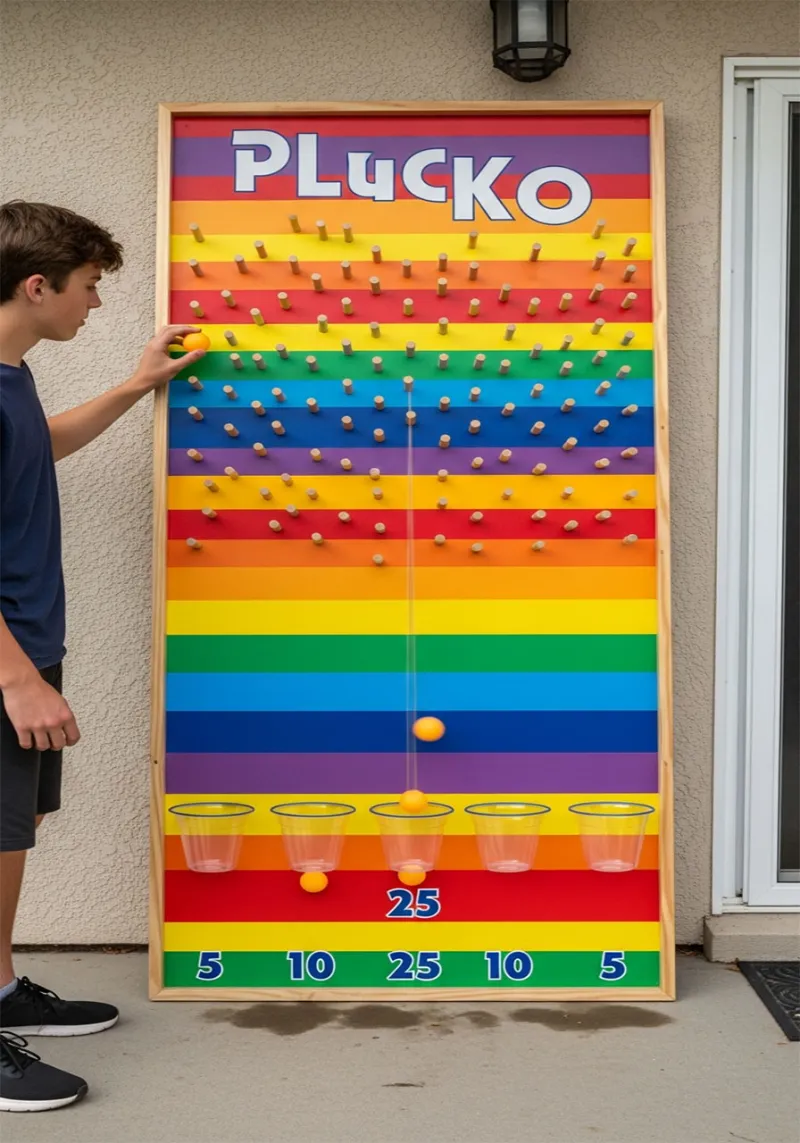
Photo: plinko board pegs ball drop casino game, via playpartygame.com
Here's a number that should bother you: if you're an active Plinko player dropping $1 bets on turbo mode, you can easily put 2,000 balls in the air during a single evening session. At a 1% house edge, that's not one loss — that's a slow, steady drip of roughly $20 an hour flowing from your wallet to the casino's. Every hour. Whether you're up or down.
That drip is the whole business model. And yet most players I talk to at US crypto casinos have no idea how the edge actually works on a Plinko board — or that some configurations leak twice as fast as others.
The Edge Isn't Hidden, It's Just Boring
Unlike a slot machine with mystery RTP figures, Plinko's house edge is right there in the payout table. The game is mathematically simple: a ball bounces through rows of pegs, and each bounce is roughly a coin flip left or right. That produces a bell curve of outcomes — most balls land in the middle slots, very few reach the edges.
The casino's profit comes from one thing: the payouts on the outer slots don't quite pay what pure odds would demand. If the far edge pays 1,000x when true odds suggest 1,010x, that gap is the rake. It's typically between 1% and 2% on legit crypto Plinko games, and it's baked into every single drop regardless of whether you win or lose.
Think of it like the vig on a sports bet or the spread at a card table. You can win individual hands all night long. The house still collects its toll on every transaction.
Run the Compounding Math (It's Ugly)
A 1% edge sounds trivial until you multiply it by volume. Let's use realistic numbers:
- Casual player: 500 drops per week at $0.50 = $250 wagered. Expected cost: $2.50/week. Cheap entertainment, honestly.
- Regular player: 2,000 drops per week at $1 = $2,000 wagered. Expected cost: $20/week, or over $1,000 a year.
- Turbo addict: 5,000 drops per week at $2 = $10,000 wagered. Expected cost: $100/week. That's a car payment annually, gone to the math.
Notice what's driving the loss. It's not the edge — it's the volume. A 1% edge on 5,000 drops costs 50x more than the same edge on 100 drops. This is why autoplay and turbo modes are the single most expensive features in crypto gambling, a point we've hammered before. The edge compounds with speed.
The Payout Table Is the Whole Game
Here's where it gets interesting for bettors who actually read the fine print. The same casino can offer wildly different leak rates depending on your settings.
Take a standard 16-row board at a typical crypto casino. On low risk, the middle slots pay around 0.5x and the edges pay maybe 16x. On high risk, the middle slots pay zero and the edges can hit 1,000x or more. Both configurations carry roughly the same house edge — but they behave completely differently.
Low risk grinds you down slowly. You hit frequent small wins that don't offset the frequent small losses. It feels safe. It isn't; it's just a slower leak.
High risk is where the real traps hide. Look closely at a high-risk table and you'll often see multiple middle slots paying 0x. That means a huge chunk of your drops — sometimes 70% or more — return absolutely nothing. The edge is the same on paper, but the variance is brutal, and your bankroll needs to survive droughts that can last hundreds of drops.
Not All Boards Are Created Equal
Row count changes everything too. An 8-row board has far fewer possible landing slots than a 16-row board, which concentrates outcomes differently and changes the payout structure entirely. A 0.9x payout on an 8-row low-risk board might actually carry a worse effective edge than a 0.2x payout on a 16-row board — you'd never know without running the expected value calculation.
And some offshore casinos quietly run worse tables than the industry standard. Two sites can both advertise "Plinko" while one returns 99% and the other returns 97.5%. Over 10,000 drops, that 1.5% difference on a $1 average bet is $150. Same game, same fun, very different bill.
What You Can Actually Do About It
You can't beat the edge — it's math, not a puzzle. But you can stop overpaying for it:
- Check the payout table before you drop. Legit provably fair games publish it. If a casino hides it, that's your answer.
- Compare expected return across configurations, not just the flashy max multiplier. The 1,000x slot is marketing; the middle slots are reality.
- Cap your drop count, not just your bet size. A $1 bet at 50 drops per minute burns faster than a $5 bet played slowly.
- Treat the edge as rent. At 1% per drop, budget your expected loss like an entertainment expense — because that's what the math says it is.
The ball doesn't care where it lands. The casino, on the other hand, knows exactly where every ball lands before you ever press the button. Play like you know too.