That Green Checkmark Means Nothing: Why 'Provably Fair' Plinko Can Still Bleed Your Wallet Dry

Photo: User:Bluemoose, CC BY-SA 3.0, via Wikimedia Commons
There's a moment every crypto Plinko player knows. You click the little 'Fairness' tab, paste in your seed, run the verifier, and watch the green checkmark appear. Everything checks out. The game is honest.
And then you check your balance an hour later and wonder where half your USDT went.
Here's the uncomfortable truth the crypto casino industry doesn't put in its marketing: provably fair and player-favorable are two completely different things. A game can be mathematically transparent and still be a money shredder. The verification badge tells you the casino isn't cheating. It says nothing about whether the game is worth playing.
What 'Provably Fair' Actually Verifies (and What It Doesn't)
Let's be precise about what the technology does. Provably fair systems use a server seed, a client seed, and a nonce to generate each result. Because the casino commits to the server seed hash before you play, it can't swap outcomes after the fact. Because you contribute the client seed, the casino can't pre-select results tailored to your balance.
That's genuinely valuable. It eliminates outright fraud — rigged RNGs, manipulated outcomes, the classic black-hat stuff.
What it does not do is change the payout table. And in Plinko, the payout table is where the game is actually decided.
Think of it this way: a fair coin flip where you win $0.90 on heads and lose $1 on tails is completely honest — and you'll still go broke. Provably fair just proves the coin is fair. It doesn't tell you the stakes are stacked.
The Payout Table Is Where They Get You
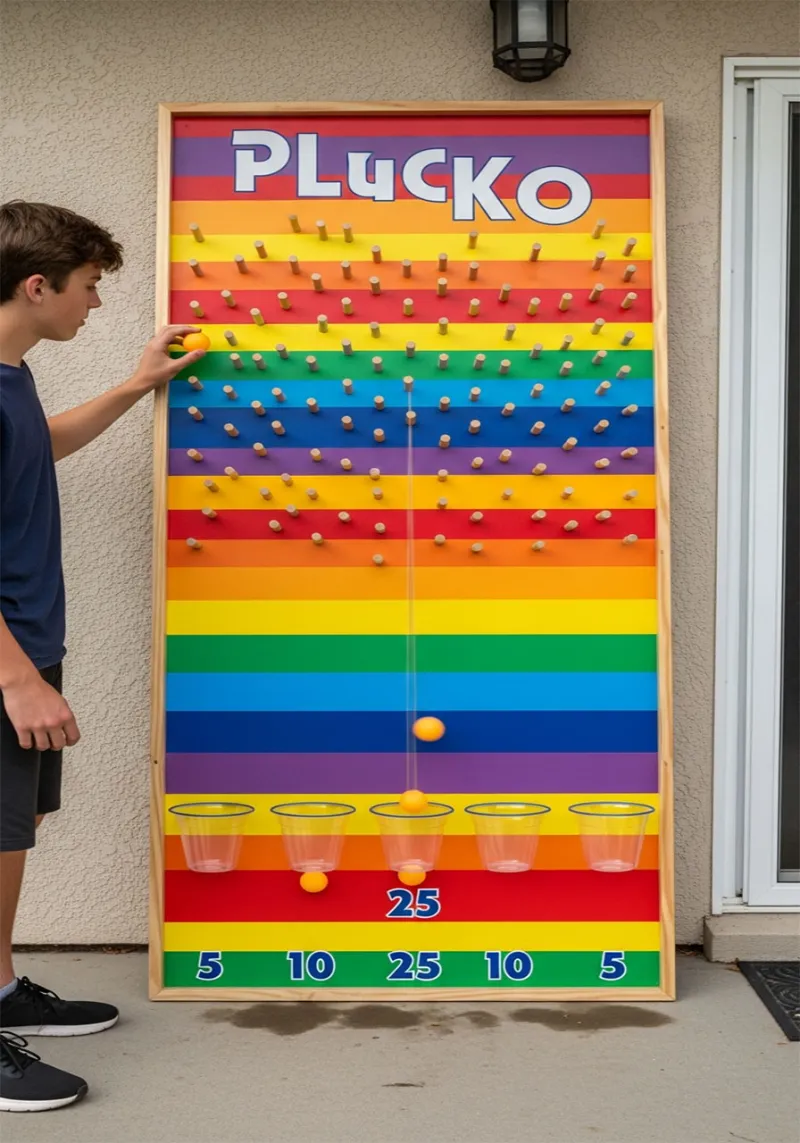
Plinko looks simple: ball drops, bounces off pegs, lands in a multiplier slot. But every Plinko implementation — Stake's original, and the dozens of clones since — has three dials the casino controls:
- Risk level (low, medium, high)
- Row count (usually 8 to 16)
- The multiplier distribution itself
Here's the part most players never do: actually compare the math across those settings. We did, running simulations on a typical high-risk 16-row board.
The headline multiplier — that shiny 1,000x slot on the far edge — hits roughly 1 in every 65,000 drops on a binomial board. Meanwhile, the slots clustered around the center, where the ball lands the overwhelming majority of the time, often pay 0.2x to 0.4x. You're losing 60–80% of your bet on most drops and chasing a jackpot that's statistically a lottery ticket.
Now here's the kicker: RTP can vary meaningfully between risk levels and row counts on the same game. Some platforms run 99% RTP on low-risk settings and quietly shave a percent or more off the high-risk boards. One percent sounds trivial. Over a few thousand autoplay drops at high speed, it's the difference between a slow bleed and a hemorrhage.
And casinos know almost nobody checks. The fairness badge does the marketing work. The payout table does the actual work.
How to Calculate What a Drop Really Costs You
You don't need to be a quant to run the numbers. Expected value (EV) is just weighted probability:
EV = (probability of each slot) × (its multiplier), summed across all slots.
For a Plinko board, the probability of landing in any given slot follows a binomial distribution — the same bell curve as coin flips. The center slots are common; the edge slots are rare. Most crypto casinos publish their multiplier tables, and there are free calculators and open-source scripts that compute binomial probabilities for any row count.
Worked example, simplified: on a 12-row board, the center slot's probability is about 22.6%. The extreme edges are around 0.024% each. Multiply every slot's probability by its multiplier, add it up, and you get the game's true RTP. If it comes out to 0.97, you're donating 3 cents per dollar per drop — and at 10 drops a minute on turbo, that's real money.
Compare that EV across risk levels. Compare it across casinos. The differences will surprise you, and not always in the direction the marketing suggests.
Three Red Flags Behind the Fairness Badge
- No published RTP anywhere. Legit platforms state their house edge. If you have to reverse-engineer it from the payout table, that's a choice they made.
- Multiplier tables that differ between the demo and the real-money game. Yes, this happens. Screenshot everything.
- 'Fairness' as the entire pitch. When a casino's homepage leads with verification badges instead of RTP, odds, or withdrawal terms, ask yourself what they're papering over. Fairness tech is cheap to license; honest margins are not.
The Bottom Line for US Players
For American bettors already operating in the gray zone of offshore crypto casinos, the calculus is doubled. You're trusting an unlicensed operator with your funds and accepting a house edge you may not have measured. The provably fair check handles trust problem number one in about thirty seconds. Problem two takes five minutes with a calculator — and almost nobody spends those five minutes.
So here's your new pre-deposit routine: verify the seed, sure. Then pull up the payout table, run the EV on your preferred risk setting, and compare it to at least two other platforms. If the numbers don't hold up, the green checkmark is just decoration on a machine designed to take your money politely.
Fair isn't the same as favorable. Never has been.