Six Banks, One Plinko Deposit: What the Money Trail Looks Like From Card Tap to Chip Drop

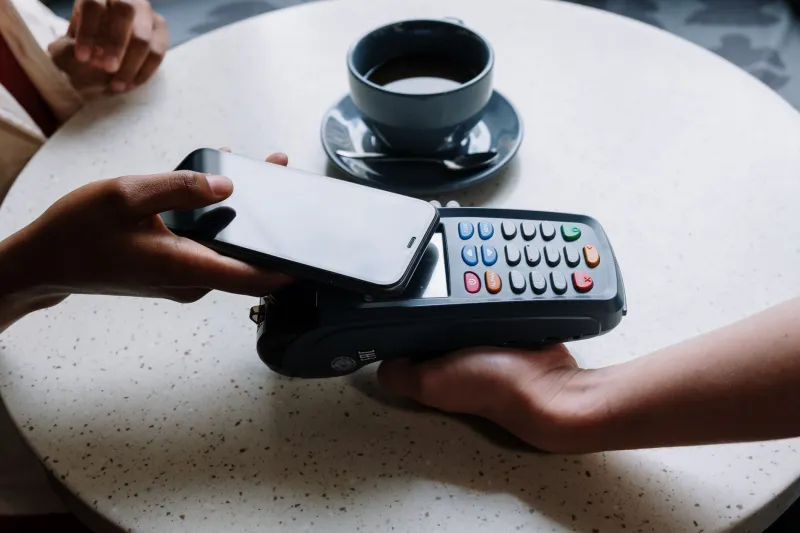
Photo: person checking banking app on phone next to laptop with crypto wallet, via get.pxhere.com
The most consequential screen in crypto Plinko is not the board. It is the one between your debit card and a USDC balance, the one that says processing while your phone sits face-down on the counter.
That screen is where your bank decides what kind of customer you are. We spent a few weeks running the same hundred dollars through six different US funding routes to see how differently each one behaves.
The Three-Legged Race
Every on-ramp is the same obstacle course in different shoes:
- You hand dollars to a payment processor. Card, ACH debit, wire, or a third-party app. This is where the fiat rails live, and where US banking rules apply.
- The processor converts to USDC and credits a wallet you control - usually a hosted balance at the on-ramp, sometimes non-custodial.
- You send that USDC to the casino, where it becomes a Plinko balance.
Each leg has its own failure mode and its own fee. Nobody markets the total.
What Fraud Models Actually See
Card networks tag merchants by code. Crypto exchanges and on-ramps typically sit in a virtual-asset or money-transfer bucket, and gambling merchants get their own code entirely. Some banks block one category, some block the other, and a few block the combination, which is exactly what a Plinko deposit looks like once you have two separate transactions in a row.
Velocity matters as much as category. A hundred-dollar card purchase from a processor you have never used, at 1 a.m. on a Sunday, from a device that just logged into a crypto casino, reads like a fraud pattern even when every single step is legitimate. That is why a first deposit often gets declined and the second attempt goes through - the model learned nothing except that you tried twice.
The Six Routes, In Practice
Our results, condensed. Account names removed, behavior kept.
- Large national bank, debit card. First attempt declined, second approved after a text-message challenge. Fee roughly 3.5 percent from the processor and a foreign-transaction fee on top. Cash advance risk with some issuers if the transaction is coded as a money transfer.
- Large national bank, ACH pull from the on-ramp. Cleared in two business days with no fee. Slower, cheapest, least dramatic. The on-ramp held the USDC until settlement, which is a feature - it gives you a built-in waiting period.
- Regional bank, ACH. Cleared, but a phone call came the next morning asking about a crypto-related debit. No block, just curiosity. Worth knowing that a human may look at your statement.
- Online-only neobank, debit card. Blocked outright at the processor. Not the bank - the processor refused the card BIN. No amount of retrying fixed it.
- Credit union, wire. Worked, cost twenty-five dollars, required a branch visit and a conversation. Highest friction, cleanest paper trail.
- Payment app transfer to a card-linked balance. Fastest of the six, and the least reversible. Once it left the app, it was gone.
The Dispute Question Nobody Asks First
Here is the part that should drive the decision: once USDC leaves your wallet for the casino, no chargeback exists. Blockchain transfers are final. Your card issuer can claw back a fraudulent on-ramp purchase; it cannot claw back a chip drop.
That means your real dispute window closes at the on-ramp, before the money ever reaches a Plinko board. If a casino disappears next week, your bank is not a backup plan. That is what on-chain transfers are, and no amount of escalation changes it.
Two further wrinkles for US players:
- ACH returns are not a free undo button. Unauthorized debits have strong protections. Authorized debits you regret do not, and repeatedly pulling back legitimate transfers gets accounts closed.
- Telling your bank the charge was fraud when it was not is a fast route to a closed account and a flag that follows you. Never do it to reverse a gambling decision.
The Real Cost per Drop
Stack the layers. Processor fee, spread between the quoted rate and the rate you got, network fee to move USDC, and the casino's own withdrawal fee if you ever cash out. On a small deposit, that stack can easily run five to eight percent round trip. On a hundred dollars, you are starting down several percent before any ball moves.
Scale matters enormously here. Fifteen dollars of friction on a hundred-dollar deposit is brutal. The same fifteen dollars on a two-thousand-dollar deposit is a rounding error. This is one of the quiet reasons small-stakes players get a worse deal than the streamers they watch.
A Practical Funding Playbook
- Use ACH when you can stand the wait. Cheapest, most reversible, and slow enough to be a speed bump.
- Keep crypto funding on a dedicated account if your main bank is skittish about gambling-adjacent activity. Do not commingle rent money with Plinko money.
- Never lie to a fraud analyst. If asked, say what the transfer was for. Misrepresenting it converts an annoying conversation into a permanent account note.
- Save every receipt - processor confirmation, on-chain transaction hash, casino deposit record. If you ever need to prove where a dollar went, you will need all three.
- Do not use a VPN to fake your location during on-ramp KYC. That is the kind of inconsistency that ends with a frozen balance and no arbitration.
What the Rail Really Decides
The casino is not the only gatekeeper in this transaction. Your bank, your processor, and your card network all get a vote before a single ball drops. Choose the cheapest rail you can tolerate, keep a paper trail, and remember that the finality of an on-chain transfer is the whole point of the technology - and the whole reason a dispute is not waiting for you at the other end.